Isolation Protection
I had been waiting for spring because the winter had been hard for us. The blossom came at just the right moment, but because of climate change, a late spring snow surprised us and threatened to destroy the blossom. I panicked and wanted to do something to protect them. I asked myself whether I could cover all of them, but it was too much. Instead, I turned to art to demonstrate my frustration at our continued inaction in the face of climate change. Nature is all we have so I covered a blossoming tree to protect it, but by doing so, I isolated it and hid its beauty – just as we have hidden ourselves for the last year and a half. We isolated ourselves to protect ourselves, covering our faces or even hiding ourselves away completely. When I covered the tree, something essential was lost. Visually distracted, like the beauty of our smiles, which have been hidden from public view. This enforced, protective isolation has changed both the tree and us. It brings to mind a recurring theme in Persian literature, in which beauty is covered, such as in a poem by Hafiz, in which the poet’s beloved has hidden her face from him.
"My love took the covers from her face, now see, we will have light again." - Hafez

Words & the Wind
I realized that I wanted to live my life like the windmill. When the wind returns, I will enjoy my life and the love of those dear to me, but until then I will lie, calm, believing in the reality of my purpose even though I cannot spin. And so, I hang, like a curtain, covered in windmills, and on those windmills are written all those things which I love, and which I have missed during this time of quarantine: Meeting new people, asking directions from strangers in the metro, exchanging smiles with people in the street – whose faces are unhidden by masks, feeling the sunshine on the backs of my hands no longer covered by gloves, arriving late to a date…
If the windmill is a metaphor for my life, I shall hang a constellation of them, multiplying the dimensions of my existence. No matter how long we must wait for the wind to come, we know that it must, and we will find our joy once more.


Atonement
This tree is dead, painted green in a hopeless, miserable attempt to return it to life. An act of atonement for the life that has been taken, even though we know, in truth, that our treachery can never be undone.
This installation represents our kind’s behaviour towards the environment. Soon, we will try to apologize, but it will be too late. The green will have gone.
This tree has been hanged for our sins

The Leaning Colours
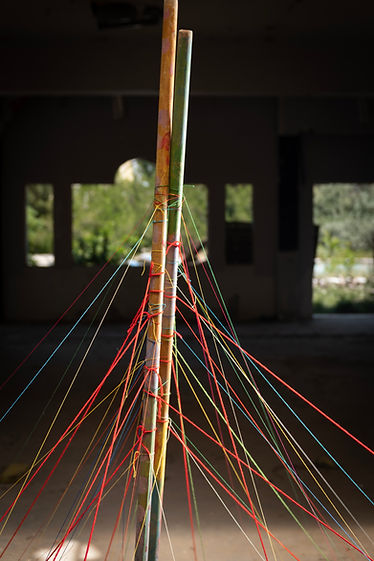
The pandemic has taught those of us who had forgotten it one universal value – of companionship, of the importance of standing with others.The act of leaning on another for support becomes a sort of dance, allowing for a kind of resonance of empathy. In this way, two sticks leaning on each other in the dark can come to symbolise this act of sympathy, in stark contrast with the devastated environment surrounding them. Colours explode uncontrollably from this feeling of connection. Colours of sympathy conquer darkness.

We the bird
The plate in this installation could depict a bird from Persian mythology. It could be either the Simorgh or the Quqnūs (Phoenix), but catalogs only describe the original as Bowl with black and mustard coloured bird design, Nishapour, Iran, 10th to 12th century, A.D. That is all we know about this historical object, reproduced here broken, representing our shattered identity. Appearing behind this brokenness is a collage of photos of Iranians coming together around the world; Like a phoenix, we will be reborn, independent of location or even time. Like the Simorgh, from our gathering, one strong, intact being will emerge.